

Understand your liability before you sell: Canadian restaurateurs with UK property face opportunities to stop house repossession in Britain, triggering tax obligations in both countries that can significantly impact your bottom line. Calculate your UK Capital Gains Tax at either 18% or 24% for residential property, depending on your total taxable income, then report this same gain to the Canada Revenue Agency on your Canadian tax return. Claim foreign tax credits through Form T2209 to prevent double taxation, ensuring you’re not paying twice on the same profit—the Canada-UK tax treaty protects you, but only if you file correctly in both jurisdictions.
If you’ve been running your restaurant empire from Toronto, Vancouver, or Montreal while holding UK property as an investment, you’re navigating two distinct tax systems simultaneously. The timing matters enormously: you have 60 days from completion of your UK property sale to report and pay UK CGT through a dedicated online portal, regardless of whether you’re a UK resident. Miss this deadline, and penalties accumulate quickly. Meanwhile, CRA expects this foreign property sale reported on your annual Canadian return, with proper documentation of all UK taxes paid.
For Canadian food entrepreneurs who invested in UK property during expansion plans or as portfolio diversification, the cross-border implications extend beyond simple calculations. Exchange rate fluctuations between your sale date and tax payment deadlines can affect your actual costs. Your restaurant’s corporate structure—whether you own the property personally or through your business—fundamentally changes your tax treatment in both countries, making professional guidance essential before signing any sale agreements.

Why Canadian Restaurateurs Are Investing in UK Property
The Allure of London’s Food Scene
London’s vibrant food scene has become a magnetic draw for Canadian restaurateurs with entrepreneurial vision. The city’s multicultural dining landscape mirrors our own Canadian culinary diversity, making it feel like a natural extension of what many operators already celebrate back home. From buzzing street food markets in Borough to innovative pop-ups in Shoreditch, London offers countless opportunities for ambitious food entrepreneurs to establish their international presence.
Beyond the cultural appeal, UK property investments often accompany these business ventures. Many Canadian restaurateurs discover that owning commercial property in London provides both stability for their operations and potential long-term returns. While supporting local businesses remains paramount at home, expanding abroad represents an exciting chapter for growth-minded operators.
The UK’s established restaurant infrastructure, combined with strong Canadian-British business ties and shared language, creates fewer barriers than other international markets. However, property ownership brings tax considerations that differ significantly from Canadian regulations, making it essential to understand how capital gains tax works when you eventually sell that cherished London location you’ve invested in.
Investment Properties vs. Business Premises
Here’s the thing about venturing into UK property as a Canadian restaurateur: the tax treatment depends entirely on what you’re actually doing with that charming Victorian building in London or that converted warehouse in Manchester.
If you’re purchasing property purely as an investment—maybe you’re buying a flat to rent out while your restaurant business stays firmly on Canadian soil—you’re looking at standard UK capital gains tax on investment property when you sell. This means you’ll pay 18% or 28% CGT (depending on your UK tax bracket) on profits above the annual exemption, currently £6,000. The CRA will also want their share of your worldwide income, though the Canada-UK tax treaty helps prevent double taxation.
Now, if you’re establishing actual restaurant operations—opening a bistro, launching a café, or pursuing international expansion with a physical business presence—that’s business premises. This changes everything. You might qualify for Business Asset Disposal Relief (formerly Entrepreneurs’ Relief), potentially reducing your CGT rate to just 10% on qualifying gains up to £1 million lifetime limit. However, you’ll need to meet specific criteria: you must have owned the business for at least two years and be actively involved in operations.
The distinction matters enormously to both HMRC and the CRA, so getting professional cross-border tax advice before purchasing is essential.
Understanding UK Capital Gains Tax Basics
What Counts as a Capital Gain?
Let’s break this down in a way that makes sense for fellow Canadians venturing into UK property investment. Think of a capital gain as simply the profit you pocket when selling your UK property for more than you paid for it.
Here’s how the calculation works: Take your selling price, then subtract what you originally paid for the property, plus any qualifying costs along the way. Those costs might include legal fees, estate agent commissions, and substantial improvements you made to the property. If you renovated that charming London flat’s kitchen to attract better tenants, those renovation costs can reduce your taxable gain.
Now, here’s where it gets interesting for Canadian restaurateurs. If you bought a commercial property in Edinburgh for your pop-up concept or invested in UK residential real estate, the moment you sell at a profit, you’ve triggered a UK capital gains tax liability. The key word is profit, though. If you sell for the same price or less than your total investment, there’s no gain to tax.
One thing that surprises many Canadians is timing. Unlike back home where you report everything on your annual tax return, UK property sales by non-residents require reporting within 60 days of completion. Missing this deadline can mean penalties, so mark your calendar.
The good news? Understanding what counts as a gain helps you plan ahead and potentially reduce your tax bill through proper documentation of all eligible expenses.
Current UK CGT Rates for Non-Residents
Let me start by explaining what you’ll actually pay when selling that UK property you’ve been holding onto. As a Canadian restaurateur, understanding these rates helps you plan ahead, much like calculating food costs before launching a new menu item.
Currently, non-UK residents face capital gains tax rates of 18% on gains within the basic rate band and 24% on gains that fall into the higher rate band when selling residential property. Think of it this way: if your UK property sale pushes your total taxable income over £50,270 for the 2024-25 tax year, you’re looking at the higher 24% rate on that portion. For commercial properties, the rates differ slightly at 10% and 20% respectively.
Here’s something important that changed recently: these rates increased from 10% and 20% for residential properties in April 2024. If you’ve been considering selling your London flat or that countryside cottage you purchased years ago, this rate jump might affect your planning significantly.
The UK also gives you an annual exempt amount, currently £3,000 for the 2024-25 tax year. It’s not much, but every bit helps when you’re managing expenses across two countries. Remember, you’ll need to report and pay this tax to HMRC within 60 days of completion, regardless of whether you owe Canadian taxes later. This isn’t like filing your annual return back home where you have months to prepare.

The Canadian Connection: How This Affects You
Canada-UK Tax Treaty Provisions
Here’s some welcome news if you’re a Canadian restaurateur with UK property investments: you won’t be taxed twice on the same gains, thanks to the Canada-UK Tax Treaty. Think of it as a culinary collaboration between two countries, working together to ensure fairness in your tax obligations.
The treaty’s primary purpose is preventing double taxation, which means when you pay capital gains tax to HMRC in the UK, you can claim a foreign tax credit on your Canadian tax return. Essentially, Canada recognizes what you’ve already paid across the pond and adjusts your obligations accordingly. This is particularly relevant when you sell that charming London property you purchased to be closer to UK suppliers or culinary markets.
Here’s how it works in practice: the UK gets first dibs on taxing the gain since the property is located there. When you report this same gain to the Canada Revenue Agency, you’ll use Form T2209 to calculate your foreign tax credit. This credit directly reduces your Canadian tax payable, dollar for dollar, up to the amount of Canadian tax that would apply to that foreign income.
However, there’s a catch worth noting. If the UK tax rate is lower than Canada’s, you might still owe some additional tax to the CRA. It’s like using premium ingredients versus standard ones – sometimes you need to top up to meet Canadian standards. Many restaurateurs find working with cross-border tax professionals invaluable for navigating these calculations, ensuring you’re claiming every credit available while staying compliant in both countries.
Reporting Requirements Back Home
So you’ve sold your UK restaurant property – congratulations! Now comes the part where you need to let the Canada Revenue Agency know what’s happening. Think of this as completing the circle on your international investment journey.
When you file your Canadian tax return for the year you sold the property, you’ll need to report the gain on a T1135 Foreign Income Verification Statement if your total foreign property cost you more than $100,000 Canadian. This form is like your CRA passport for international assets – it tracks what you own beyond our borders. You’ll also report the actual capital gain on Schedule 3 of your tax return, converting everything to Canadian dollars using the Bank of Canada exchange rate on the transaction date.
Here’s where things get friendlier: Canada and the UK have a tax treaty specifically designed to prevent you from being taxed twice on the same income. Through the foreign tax credit system, you can claim credit for the UK capital gains tax you already paid. You’ll use Form T2209 to calculate this credit, which directly reduces your Canadian tax owing. It’s essentially the government’s way of saying, “We see you already paid tax over there, so we’ll give you credit here.”
Keep every piece of documentation – your UK tax computation, proof of payment to HMRC, solicitor statements, and exchange rate calculations. The CRA might want to verify your numbers, and having everything organized makes the process smooth. Consider working with an accountant who understands cross-border taxation, especially if this is your first time navigating international property sales. They’ll ensure you’re claiming all available credits while staying compliant with both countries’ requirements.
Recent Changes That Impact Your Bottom Line
The 30-Day Reporting Rule
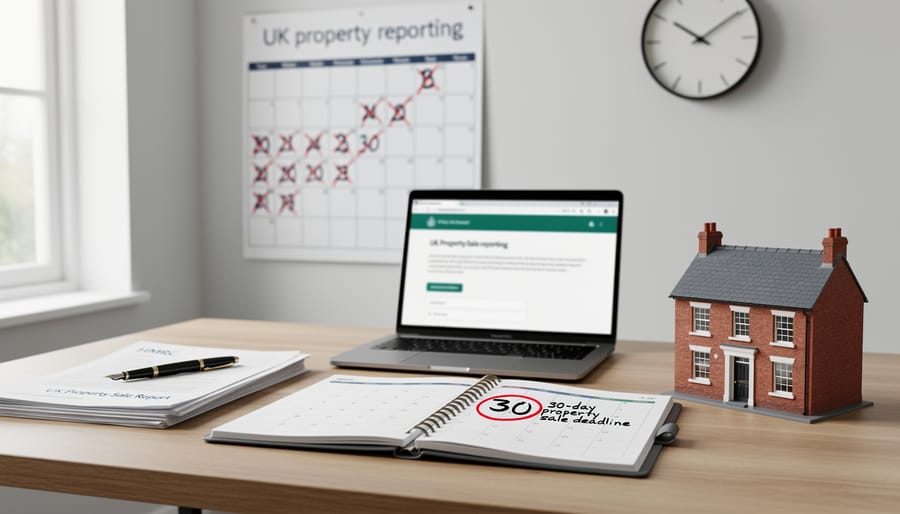
Here’s something that catches many Canadian restaurateurs off guard: when you sell UK property, you’ve got just 30 days to report it to HMRC and pay any capital gains tax owing. Yes, you read that right – 30 days, not the leisurely timeline we’re used to back home with our annual tax filings.
This deadline applies whether you’re selling that charming London flat you’ve been renting out or the Edinburgh property where you tested opening a second location. The clock starts ticking from the completion date of your sale, and HMRC takes this seriously.
Missing this deadline isn’t like forgetting to file a receipt. You’re looking at penalties starting at 5% of the tax owed, with additional charges piling up if you’re really late. For a significant property sale, those penalties can quickly rival what you’d spend on a full kitchen renovation.
The reporting happens through HMRC’s online system, and here’s the kicker – you need to calculate and pay the tax upfront, before your annual Self Assessment. Think of it like prep work in the kitchen: you can’t start service without mise en place, and you can’t delay this filing without consequences. Many Canadian property owners work with UK tax advisors to navigate this tight timeline, especially when juggling business operations across the Atlantic.
Rate Increases and What They Mean in Real Dollars
Let’s break down what these tax rate changes mean for your wallet with some real-world numbers. Imagine you purchased a charming London flat near Borough Market back in 2018 for £300,000, thinking it would be perfect for your culinary research trips. Fast forward to today, and you’re selling it for £450,000—that’s a £150,000 gain.
Under the previous UK rate of 28% for higher-rate taxpayers, you’d owe £42,000 in capital gains tax (after your £3,000 annual exemption). With the new 24% rate, that same sale would cost you £35,280—a savings of £6,720. That’s enough to fund several farm-to-table dining experiences or invest in new kitchen equipment back home in Canada.
For Canadian restaurateurs running on tight margins, these differences add up quickly. If you bought multiple properties or a larger commercial space, the savings multiply proportionally. A £300,000 gain that once meant £84,000 in taxes now translates to £71,760—saving you over £12,000.
Remember, you’ll still need to report this to the CRA, and Canadian taxes may apply depending on your residency status and our tax treaty provisions, but understanding the UK side helps you plan more accurately for your total tax obligation.
Smart Strategies to Minimize Your Tax Bill
Timing Your Sale for Maximum Benefit
Timing can make a substantial difference to your tax bill when selling UK property. The UK tax year runs from April 6th to April 5th, which differs from Canada’s calendar year system. If you’re close to a tax year boundary, waiting a few weeks could allow you to spread gains across two years or benefit from a fresh annual exemption.
Consider your personal circumstances on both sides of the Atlantic. If you’ve had a particularly high-income year in Canada, adding UK property gains might push you into a higher tax bracket. Conversely, a lower-income year could be the perfect time to realize gains and minimize your overall tax burden.
Keep exchange rates in mind too. Since you’ll calculate gains in British pounds but report in Canadian dollars to the CRA, currency fluctuations can impact your actual tax liability. A strong pound relative to the Canadian dollar when you purchased, followed by a weaker pound at sale, could work in your favour.
Don’t forget about the 60-day reporting deadline to HMRC after completion. Planning your sale timing means ensuring you have sufficient time to gather documentation and file accurately without rushing, especially when coordinating across time zones and two tax systems.
Deductible Expenses and Improvements
Here’s some good news that’ll put a smile on your face: many expenses connected to your UK property can actually reduce your capital gains tax bill. Think of it as getting credit for all the hard work and investment you’ve put into that property across the pond.
Renovation and improvement costs are your friends here. If you’ve upgraded the kitchen (perhaps dreaming of that professional-grade setup you’d love in your own restaurant?), added an extension, or made structural improvements, these typically count as allowable expenses. However, regular maintenance and repairs don’t qualify, so repainting walls or fixing a leaky tap won’t help your tax situation.
Legal fees and professional costs matter too. The solicitor fees you paid when purchasing the property, survey costs, and estate agent fees when selling can all be deducted from your gain. Even stamp duty land tax paid on purchase counts toward reducing your taxable amount.
Keep those receipts organized! HMRC wants proof of every expense you claim, so maintaining a well-documented file is essential. Many Canadian restaurateurs find it helpful to work with accountants familiar with both UK property taxation and CRA reporting requirements, ensuring nothing falls through the cracks. This investment in professional guidance often pays for itself through legitimate deductions you might otherwise miss.
Principal Private Residence Relief Options
Here’s some welcome news for Canadian restaurateurs who’ve called their UK property home: you might qualify for Principal Private Residence (PPR) relief, which can significantly reduce your capital gains tax bill. Think of it as the UK’s equivalent to Canada’s principal residence exemption, though with its own unique flavour.
If you lived in your UK property as your main home at any point during ownership, you could claim partial or full relief on the gain. Perhaps you ran a restaurant-café hybrid with living quarters above, or relocated to London for a few years to master British pub fare before returning to Toronto. The relief applies proportionally to the time you actually resided there.
The calculation considers the total ownership period versus residence period. You’ll also receive automatic relief for the final nine months of ownership, regardless of where you lived. For Canadian restaurateurs who purchased UK property for both business exploration and accommodation, keeping detailed records of your residency periods becomes crucial. Document everything from utility bills to local restaurant receipts showing your UK presence—these prove invaluable when calculating your relief and explaining your situation to both HMRC and the CRA back home.
Real-World Scenario: A Toronto Restaurateur’s Experience
Meet Sarah Chen, owner of three thriving Toronto restaurants specializing in contemporary Canadian cuisine with Asian influences. Back in 2015, when the Canadian dollar was strong and London’s food scene was booming, Sarah purchased a commercial property in Camden with dreams of opening a UK outpost of her flagship restaurant.
Fast forward to 2023, and Sarah’s plans had changed. Her Toronto locations were flourishing, and managing a UK property from across the Atlantic proved more challenging than anticipated. When she sold the Camden property for a substantial profit, she was thrilled until her accountant mentioned the dreaded words: capital gains tax.
Here’s where things got interesting. Sarah discovered she owed capital gains tax to both UK authorities and potentially the CRA. The property had appreciated significantly, and at 28 percent for UK residential property or up to 24 percent for commercial property, plus potential Canadian tax obligations, the bill was eye-opening.
Fortunately, Sarah worked with cross-border tax specialists who helped her navigate the Canada-UK tax treaty. She learned that foreign tax credits could prevent double taxation, meaning taxes paid to the UK could offset her Canadian obligations. She also discovered she could claim allowable expenses like renovation costs and legal fees, which reduced her taxable gain considerably.
The process taught Sarah valuable lessons. She wished she’d understood the annual tax-on-account system in the UK, which requires advance payments toward your tax bill. Missing those deadlines meant penalty fees she could have avoided. She also learned that keeping meticulous records of every improvement made to the property was crucial for claiming deductions.
Sarah’s advice to fellow Canadian restaurateurs? Don’t wait until sale day to think about capital gains tax. Connect with accountants familiar with both Canadian and UK tax systems early, keep impeccable records, and factor potential tax liabilities into your investment decisions from day one. Her experience turned a complex situation into a manageable one, allowing her to focus on what she loves most: creating extraordinary dining experiences back home in Toronto.

When to Seek Professional Help
Let’s be honest – if you’ve read this far and your head is spinning faster than a stand mixer on high, you’re not alone! UK property capital gains tax combined with Canadian tax obligations can feel like trying to perfect a complex mille-feuille without a recipe. Sometimes, the smartest move a restaurateur can make is knowing when to call in professional help.
So when should you reach out to an expert? If you’re dealing with multiple properties, commercial real estate alongside residential, or if you’ve owned your UK property for many years with complex renovations and improvements, it’s time. Similarly, if you’re unsure about treaty benefits, foreign tax credits, or how to properly report to both HMRC and the CRA, don’t go it alone.
Look for cross-border tax specialists who understand both UK and Canadian tax systems – they’re like the culinary translators of the tax world. These professionals can help you navigate currency conversions, timing strategies for sales, and ensure you’re not accidentally paying tax twice on the same gains. In Canada, seek out accountants with international tax experience, particularly those familiar with the Canada-UK tax treaty.
UK-based chartered accountants can handle the HMRC side, ensuring proper calculations and timely filings overseas. Many Canadian restaurateurs find success working with a team approach: a UK accountant managing the British side and a Canadian cross-border specialist coordinating CRA obligations.
The cost of professional guidance typically pales in comparison to the penalties, interest, and overpaid taxes that can result from DIY mistakes. Think of it as investing in the right kitchen equipment – sure, you could muddle through without it, but the results and efficiency speak for themselves.
Navigating UK property capital gains tax might feel like tackling a complex recipe with unfamiliar ingredients, but you’ve got this. The key takeaway? Knowledge and preparation are your best tools. Whether you’re running a bustling Toronto bistro with a London rental on the side or considering your first overseas property investment to expand your culinary empire, understanding your tax obligations on both sides of the Atlantic isn’t optional—it’s essential.
Remember, the Canada-UK tax treaty exists to protect you from double taxation, but only if you know how to use it properly. Keep meticulous records of your property expenses, renovation costs, and currency exchange rates. These details matter when calculating your gain and can significantly reduce your tax burden. And please, don’t wait until you’ve sold the property to think about tax implications. That’s like seasoning a dish after it’s already plated—too late to make the best impact.
You’re part of a growing community of Canadian food entrepreneurs making bold international moves, from pop-up restaurants in Edinburgh to property investments across the UK. These ventures take courage, creativity, and smart planning. Connect with cross-border tax professionals who understand both Canadian and UK systems—they’re worth every penny. Your culinary passion drove you to explore opportunities beyond Canada’s borders, so approach the tax side with that same proactive spirit. Take control, plan ahead, and keep building your international success story.